Gas per bet: what one on-chain bet really costs on Base, Arbitrum and Polygon
Chains and wallets · costs
Every on-chain bet pays gas in the chain's own coin, on top of the game's edge. We read three real Dice bets from March 2026 in Blockscout: 0.0000024 ETH on Base, 0.0000064 ETH on Arbitrum and 0.0094 POL on Polygon. Here is what those numbers mean and what makes them go up.
At an account casino a bet costs you the house edge and nothing else. At a decentralized crypto casino each bet is also a transaction, and each transaction pays the network. On the chains where live platforms run, that fee is small. It is also paid every single time, in a coin you might not have thought to hold. Here is what it looks like with real numbers.
Three real bets
We took three Dice bets placed on BetSwirl in March 2026, one per chain, and read them in Blockscout. BetSwirl has since wound down, but its bets are an ordinary contract call of the kind every on-chain casino makes, which makes them a fair benchmark.
| Chain | Date | Gas used | Fee paid | Transaction |
|---|---|---|---|---|
| Base | 22.03.2026 | 403,875 | 0.0000024 ETH | 0x383f8c69…ecd184a |
| Arbitrum One | 20.03.2026 | 318,668 | 0.0000064 ETH | 0xfc7ab9f8…4c379c6f69 |
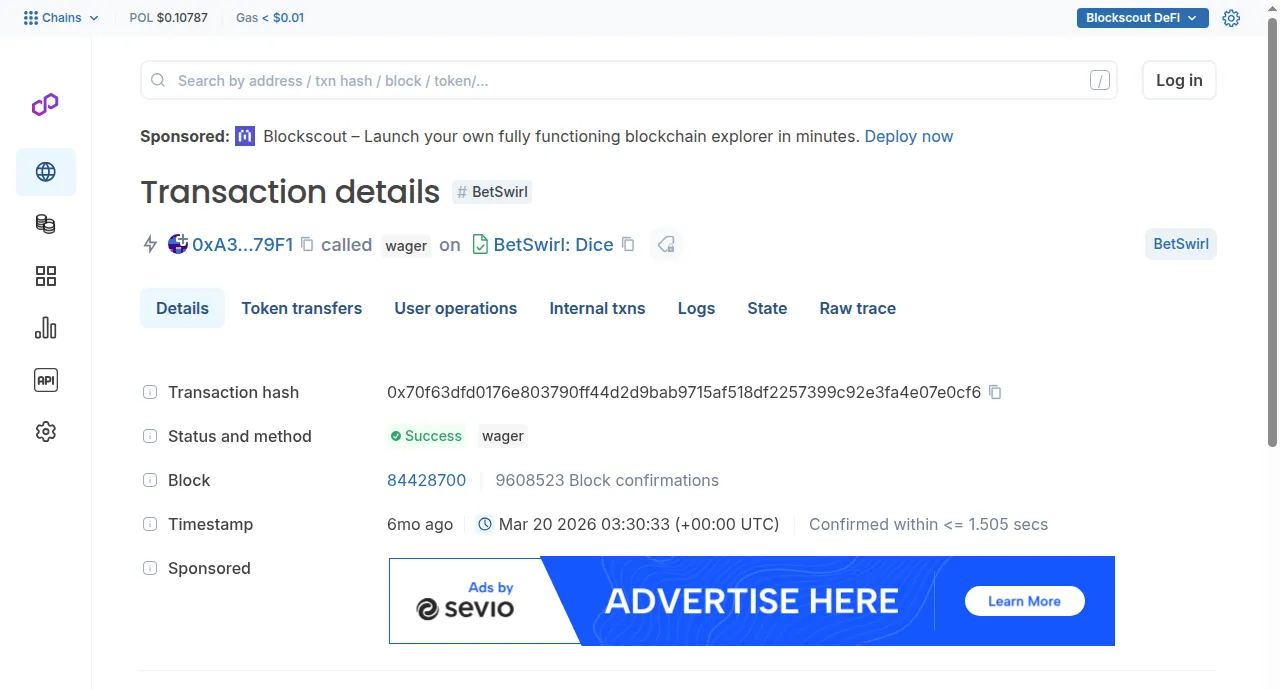
| Polygon PoS | 20.03.2026 | 314,482 | 0.0094 POL | 0x70f63dfd…4e07e0cf6 |
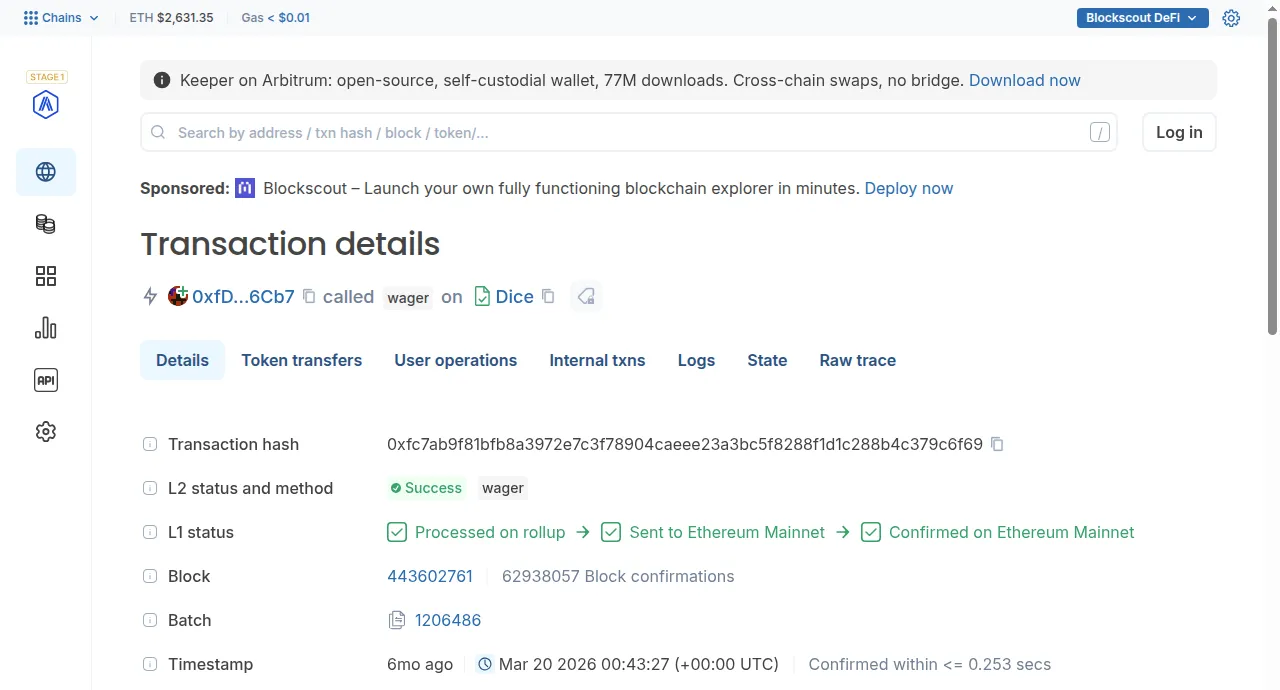
Gas used is the amount of computation: between about 314,000 and 404,000 units for a Dice bet. The fee is gas used times the gas price at that moment, paid in the chain's native coin. On Base and Arbitrum it was a few millionths of an ETH. On Polygon it was under a hundredth of a POL.
What makes it go up
Network activity. Gas prices rise when a chain is busy. On layer 2s the change is usually small in absolute terms.
The coin's price. A fee of 0.0000064 ETH is worth more when ETH is worth more.
More steps per game. A dice roll is one call. Card games with several decisions can take several transactions; Overtime uses staged randomness for its card games, drawing in steps as the hand develops.
Randomness fees. Platforms that use an oracle for randomness pay it per request. On a contract casino part of what you send with a bet can be that fee, and a transaction's logs show the split.
Approvals. The first time you bet a token, you sign an approval. That is a separate transaction with its own gas.
What it means for how you play
Gas is a fixed cost per bet, so it matters most on small, frequent bets. A hundred small bets pay a hundred fees; one larger bet pays one. On the layer 2s where these platforms run, even a long session rarely costs much in gas, but it is worth knowing it's there when you set a budget.
| You play | Gas matters |
|---|---|
| A few larger bets on sports | Hardly at all |
| Casino games, a normal session | A little; keep some ETH or SOL for it |
| Many tiny bets | Proportionally a lot; an account casino may be cheaper |
Smart accounts and gas
Overtime's smart account, opened with a social login, removes the browser extension from the picture. It doesn't make the chain free: each bet is still a transaction on Optimism, Arbitrum or Base, and the gas is still paid.
Comparing with an account casino
At an account casino the network fee appears twice, on the way in and on the way out, and every bet between is free on-chain. Stake, for example, lists the networks it accepts for deposits, including Ethereum, BSC, Polygon, Tron and Solana, and says Arbitrum, Optimism and Base are not supported. If you play many small bets and don't need custody, that model is cheaper.
Keeping gas under control
- Keep a small, separate balance of the gas coin; don't let it run to zero mid-session.
- Play on a layer 2 or Solana, not mainnet.
- Approve the amount you plan to bet once, rather than many small approvals, and revoke it after.
- Look up your first bet on the explorer to see what you actually paid.
Which chain has which platforms is on casinos by chain. How gas fits into the wallet-fit score is on how we score, and all six platforms are compared on the decentralized crypto casino ranking.